
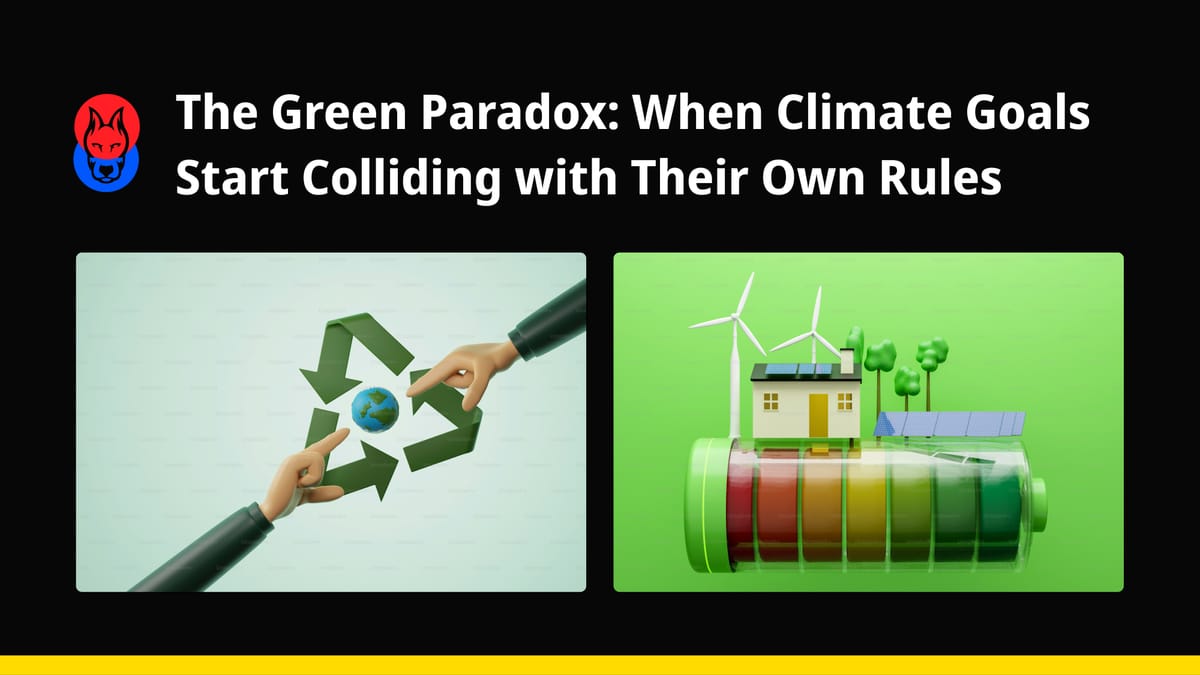
The Green Paradox: When Climate Goals Start Colliding with Their Own Rules
Environmental Regulation, ESG Friction & Investment Asymmetry

Doberman VC — Research Note | October 2025
Theme: Environmental Regulation, ESG Friction & Investment Asymmetry
Theme: Environmental Regulation, ESG Friction & Investment Asymmetry
There’s an irony that’s becoming impossible to ignore.
The same ESG framework that once fueled the green transition is now slowing it down.
Governments wanted “clean energy.”
Now they want it perfectly clean — zero waste, zero emissions, zero compromise.
And that’s where the math starts to break.
The New ESG Paradox
Across the EU and OECD countries, a quiet shift is taking place:
renewables are no longer treated as an exemption — they’re treated as a liability class under ESG law.
- The EU now mandates 100% recyclability of wind turbine blades.
- Fiberglass and epoxy composites can’t be dumped or landfilled anymore.
- Each blade costs 5–8x more to recycle than to produce.
- New environmental restrictions limit wind and solar installations in “bird migration corridors” and scenic zones.
- What was once “green innovation” now faces the same red tape as heavy industry.
- And then there’s the battery & panel waste problem.
- Solar and EV waste is projected to hit 78 million tons by 2050.
- Most recycling facilities today can process less than 20%.
What was meant to save the planet is now buried under its own sustainability paperwork.
A Market Forming in the Shadows
Where bureaucracy expands, new markets emerge.
The ESG paradox is giving rise to a new subsector: green waste tech — companies built around recycling and reusing renewable components.
- Li-Cycle and Redwood Materials are pioneering battery recycling ecosystems, focusing on nickel, cobalt, and lithium recovery.
- Umicore is expanding into closed-loop solar and EV recycling — turning regulation into revenue.
- Smaller innovators are experimenting with bio-based resins and recyclable blade composites.
This is not philanthropy.
It’s the next logical step in the value chain — from generation to regeneration.
The Investment Angle
For investors, this paradox creates a two-tier opportunity.
- Recycling and circular economy plays — the new infrastructure layer of the energy transition.
- Think: Li-Cycle, Redwood, Umicore, or ETF exposure to “green waste” technology.
- Scale-based moats — large energy players who can absorb ESG compliance costs.
- Iberdrola, NextEra, Siemens Energy — their advantage grows as smaller developers are priced out by regulation.
- Policy arbitrage — regions with lighter ESG restrictions will attract manufacturing spillover and investment (e.g., parts of Southeast Asia, UAE).
Regulation, ironically, becomes both a headwind and a moat.
The Big Picture
The story of renewables is evolving.
Phase 1 was innovation.
Phase 2 was scale.
Phase 3 — where we are now — is compliance.
And compliance is expensive.
But every constraint births a new opportunity.
For those watching the flows, green regulation is becoming the new alpha source.
The cleanest energy might not be the one that shines brightest —
but the one that survives the rules it helped create.
Key Watchlist
- Li-Cycle (LICY)
- Redwood Materials (Private)
- Umicore (UMI.BR)
- Iberdrola (IBE.MC)
- NextEra (NEE)
- Siemens Energy (ENR.DE)